Bubbleformer
Accepted to NeurIPS 2025 as a Spotlight Paper🏅
[Paper] [Poster] [Dataset on Hugging Face (BubbleML 2.0)]
A transformer model for long range forecasting of boiling phenomena (an inherently chaotic, multiphase process central to energy and thermal systems) that generalizes across different liquids such as dielectrics and refrigerants.
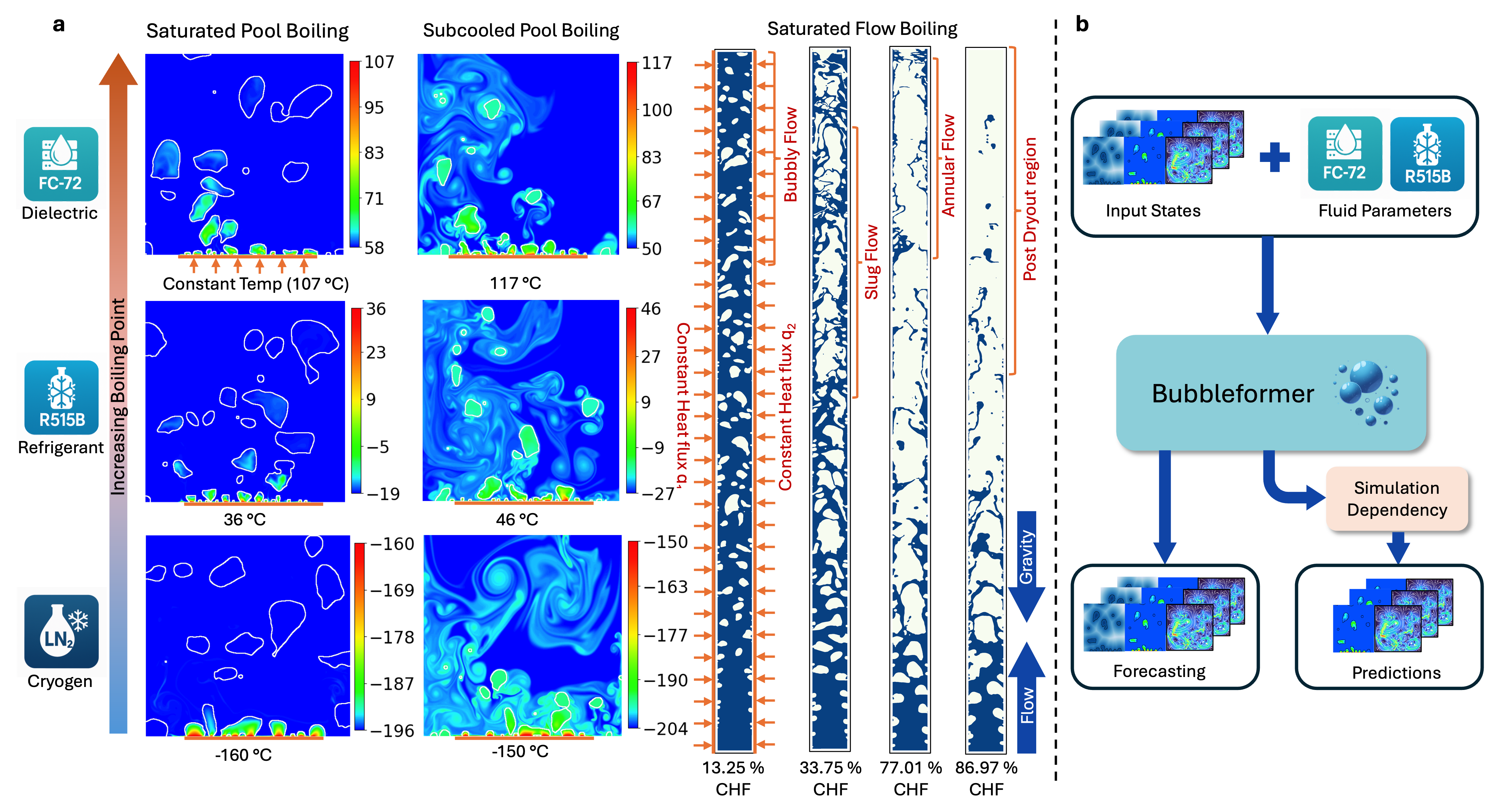 Figure 1: Overview of BubbleML 2.0 dataset and Bubbleformer downstream tasks
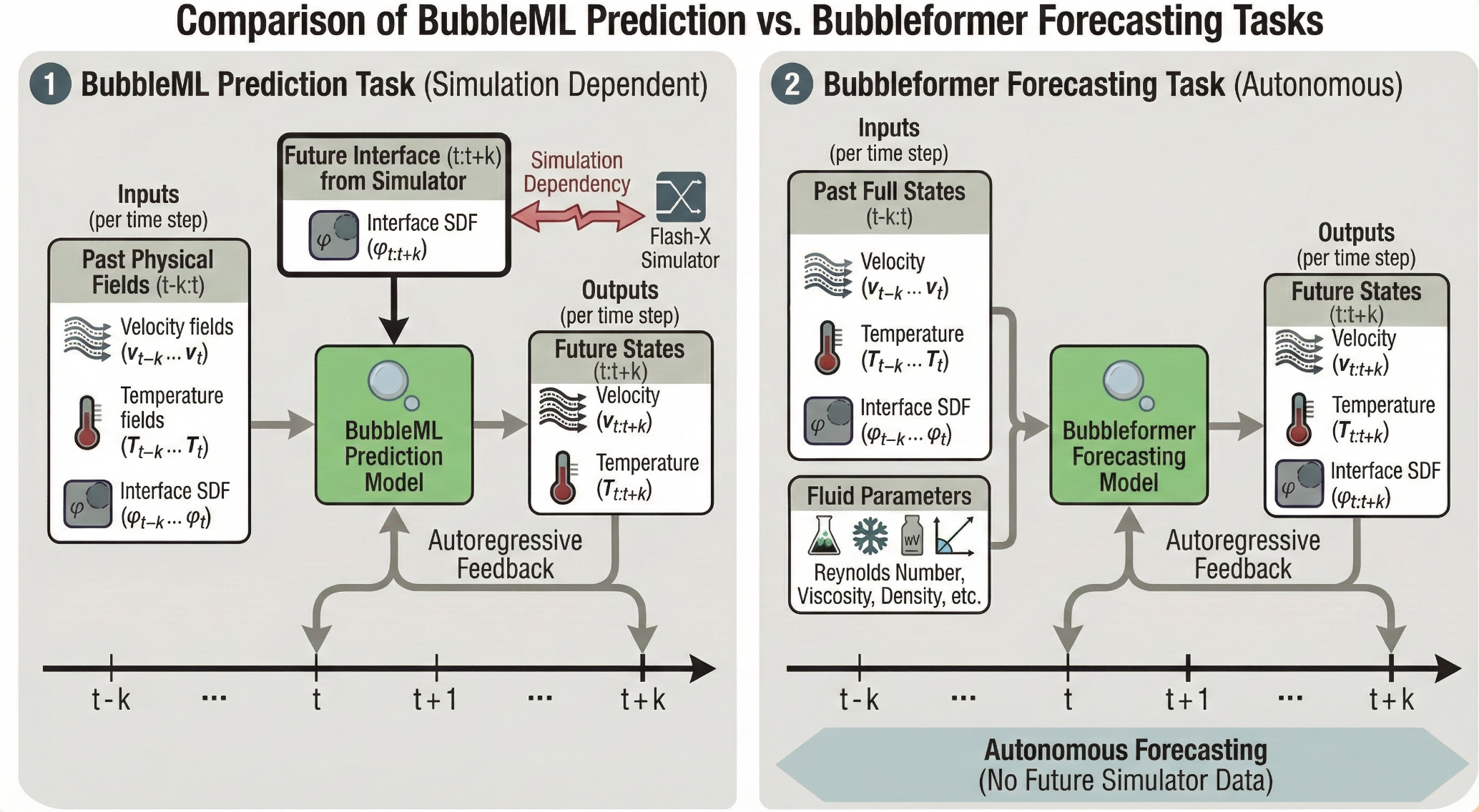 Figure 2: Task overview showing the prediction and forecasting problem setup
Prior Work
This work builds upon BubbleML, which was accepted as a NeurIPS 2023 Datasets and Benchmarks Spotlight. BubbleML introduced the first large-scale multiphase boiling dataset for machine learning research.
- BubbleML Paper: NeurIPS 2023 Proceedings
- BubbleML 1.0 & 2.0 Dataset: Hugging Face
Overview
Bubbleformer is a transformer-based spatiotemporal model that forecasts stable and long-range boiling dynamics (including nucleation, liquid-vapor interface evolution, and heat transfer) without dependence on simulation data during inference. The project combines:
- Bubbleformer: A novel transformer architecture for forecasting multiphase fluid dynamics
- BubbleML 2.0: A comprehensive dataset of boiling simulations across diverse fluids and configurations
Together, they enable machine learning models to generalize across different fluids and physical configurations, setting new benchmarks for ML-based modeling of complex thermophysical systems.
Bubbleformer Model
Bubbleformer makes three core contributions to the field:
- Beyond prediction to forecasting
- Operates directly on full 5D spatiotemporal tensors while preserving temporal dependencies
- Learns nucleation dynamics end-to-end, enabling long-range forecasting
- Requires no compressed time representations or injected future bubble positions
- Generalizing across fluids and flow regimes
- Conditions on thermophysical parameters for cross-liquid generalization (cryogenics, refrigerants, dielectrics)
- Supports multiple boiling configurations (pool/flow boiling) and geometries (single/double-sided heaters)
- Physics-based evaluation
- Introduces interpretable metrics beyond pixel-wise error:
- Heat flux divergence
- Eikonal PDE for signed distance functions
- Mass conservation
- Evaluates physical correctness in chaotic systems
- Introduces interpretable metrics beyond pixel-wise error:
Model Architecture
The primary model in Bubbleformer is:
- FiLMAViT : An Axial Vision Transformer with factored spacetime blocks, FiLM Layer for fluid parameter conditioning and techniques to preserve high frequency components.
BubbleML 2.0 Dataset
BubbleML 2.0 is the most comprehensive boiling dataset to date, significantly expanding the original BubbleML with new fluids, boiling configurations, and flow regimes.
Key Features
- 160+ high-resolution 2D simulations spanning:
- Pool boiling and flow boiling configurations
- Diverse physics (saturated, subcooled, and single-bubble nucleation)
- Three fluid types:
- FC-72 (dielectric)
- R-515B (refrigerant)
- LN$_2$ (cryogen)
- Experimental conditions:
- Constant heat flux boundary conditions
- Double-sided heater configurations
- Full range of flow regimes (bubbly, slug, annular until dryout)
Technical Specifications
- Simulation framework: All simulations performed using Flash-X
- Data format: HDF5 files
- Resolution:
- Spatial and temporal resolution varies by fluid based on characteristic scales
- Adaptive Mesh Refinement (AMR) used where needed
- AMR grids interpolated to regular grids with:
- Linear interpolation
- Nearest-neighbor interpolation for boundary NaN values
- Contents: Each simulation includes:
- Temperature fields
- Velocity components (x/y)
- Signed distance functions (bubble interfaces)
- Thermophysical parameters
For additional details on boundary conditions, numerical methods, and experimental validation, please refer to the bubbleformer paper Appendix B.
Installation
You can use uv to setup the python environment and install dependencies.
uv venv
source .venv/bin/activate
uv sync
uv pip install -e .
Repository Structure
.
├── bubbleformer/              # Main package directory
│   ├── config/                # Configuration files
│   │   ├── data_cfg/          # Dataset configurations
│   │   ├── model_cfg/         # Model configurations
│   │   ├── optim_cfg/         # Optimizer configurations
│   │   └── scheduler_cfg/     # Learning rate scheduler configurations
│   ├── data/                  # Data loading and processing modules
│   ├── layers/                # Model layer implementations
│   ├── models/                # Model architecture implementations
│   └── utils/                 # Utility functions (losses, plotting, etc.)
├── env/                       # Environment configuration files
├── examples/                  # Example notebooks
├── samples/                   # Sample data files
└── scripts/                   # Training and inference scripts
Usage
Training
To train a model using the default configuration:
python scripts/train.py
To train with a specific configuration:
python scripts/train.py nodes=1 devices=1 max_epochs=400 batch_size=8
Inference
The repository provides two ways to run inference:
- Using the Python script:
python scripts/inference.py --model_path /path/to/model --data_path /path/to/data - Using the Jupyter notebook:
scripts/inference_autoregressive.ipynb